

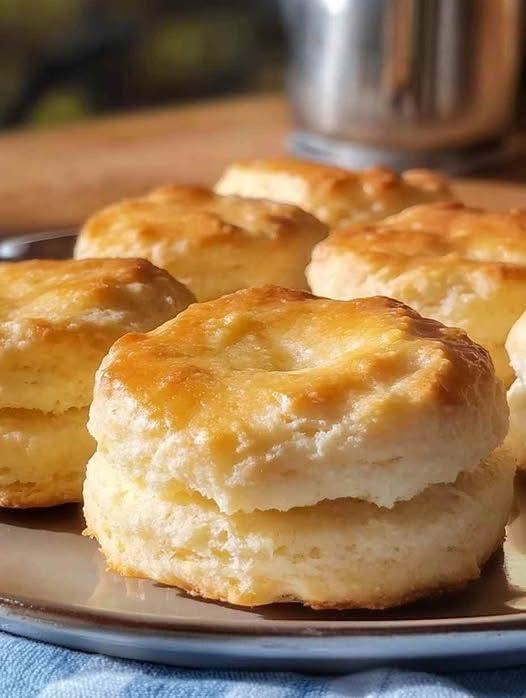
Here is a detailed guide to making Heavenly Angel Biscuits, a classic Southern recipe that lives up to its name. These biscuits are unique because they combine three leavening agents—yeast, baking powder, and baking soda—resulting in a texture that is simultaneously light, fluffy, and tender, almost like a cross between a traditional biscuit and a dinner roll .
The recipe below synthesizes the most popular and highly-rated versions, including those attributed to Paula Deen, to bring you a reliable and delicious result .
Heavenly Angel Biscuits
Yield: About 2 dozen biscuits
Prep time: 30 minutes
Rise time: 2 to 2.5 hours (or refrigerate overnight)
Bake time: 10-15 minutes
Ingredients
For the Dough:
· 5 cups all-purpose flour, plus more for dusting
· ¼ cup granulated sugar
· 2 teaspoons salt
· 1 teaspoon baking powder
· 1 teaspoon baking soda
· 1 cup cold unsalted butter, cut into tablespoon-sized pieces (or 1 cup shortening)
· ¼ cup warm water (105°F to 115°F)
· 2 (¼-ounce) packages active dry yeast (about 4.5 teaspoons total)
· 2 cups buttermilk
For Finishing:
· 2 tablespoons unsalted butter, melted (for brushing)
· Nonstick cooking spray, for the baking sheet
Instructions
Step 1: Activate the Yeast
- In a small bowl, combine the warm water (105-115°F) and the two packages of active dry yeast. The water should feel like warm bath water.
- Add the sugar to the yeast mixture and stir gently to dissolve .
- Let it stand for 5 to 10 minutes until the mixture is foamy. This “proofs” the yeast, confirming it’s active and ready to use .
Step 2: Combine Dry Ingredients
- While the yeast is proofing, in a very large bowl, whisk together the 5 cups of all-purpose flour, salt, baking powder, and baking soda. Whisking ensures the baking powder and soda are evenly distributed .
Step 3: Cut in the Butter
- Add the cold butter pieces to the flour mixture.
- Using a pastry blender, two forks, or your fingertips, cut the butter into the flour until the mixture resembles coarse crumbs with some pea-sized butter bits remaining. This is key for a flaky texture .
Step 4: Form the Dough
- Make a well in the center of the flour mixture.
- Pour in the foamy yeast mixture and the 2 cups of buttermilk .
- Stir with a sturdy spoon or spatula just until the dough comes together and is moistened. It will be quite sticky . Do not overmix.
Step 5: First Rise (or Overnight Rest)
· Option A (For Next Day): This is a popular method. Cover the bowl tightly with plastic wrap and refrigerate overnight. The dough will rise slowly in the fridge .
· Option B (For Same Day): Cover the bowl with plastic wrap or a clean kitchen towel and let it rise in a warm, draft-free place until doubled in size. This can take 1.5 to 2.5 hours .
Step 6: Shape the Biscuits
- When you’re ready to bake, preheat your oven to 400°F (200°C) . Spray a large baking sheet with nonstick cooking spray or line it with parchment paper .
- Turn the dough out onto a generously floured surface. If the dough was refrigerated, it will be firm but workable.
- Gently pat (or lightly roll) the dough to about ¾-inch thickness . Be careful not to overwork it; handle it gently.
- Use a 2 ½-inch round biscuit cutter dipped in flour to cut out biscuits. Press straight down without twisting to ensure they rise evenly .
- Place the biscuits on the prepared baking sheet, spacing them about 1 inch apart for crusty sides or closer together for soft-sided biscuits .
- Gather the scraps, gently press them together, and continue cutting until all dough is used.
Step 7: Second Rise
- Cover the biscuits loosely with a kitchen towel and let them rise in a warm place until they look puffy and have increased in size. This can take about 1 to 2 hours for dough that hasn’t risen yet, or a shorter time for dough that has already risen overnight .
Step 8: Bake
- Place the risen biscuits in the preheated 400°F (200°C) oven.
- Bake for 10 to 15 minutes, or until the tops and bottoms are beautifully golden brown .
- Remove from the oven and immediately brush the hot biscuits with melted butter .
- Serve warm. These are best enjoyed fresh from the oven.
Chef’s Tips for Heavenly Success
· The Magic is in the Mix: The combination of yeast and chemical leaveners (baking powder/soda) is what makes these “angelic.” The yeast provides a complex flavor and light texture, while the baking powder gives them an immediate rise in the oven .
· Butter vs. Shortening: Many classic recipes use shortening for a very tender biscuit . However, the versions using cold butter (especially those attributed to Paula Deen) are praised for their even flakier, richer layers . Both work wonderfully.
· Temperature Matters: The buttermilk and water temperatures are important. The water needs to be warm to activate the yeast (105-115°F), but the buttermilk can be cold to help keep the butter solid, which creates flaky layers.
· Don’t Skip the Rest: The rising time is crucial for developing that light, airy texture. Allowing the dough to rest overnight in the fridge also develops a more complex, tangy flavor .
· Make-Ahead Magic: The unbaked dough can be kept in the refrigerator for up to a week . You can also cut out the biscuits, freeze them solid on a baking sheet, and then transfer them to a freezer bag. Bake them from frozen, adding a few minutes to the baking time .
· Versatility: This dough isn’t just for biscuits! It can be used to make cinnamon rolls, garlic-cheese pull-aparts, or even as a base for quick hamburger buns .